Schema design
Schema design decides tables, columns, types and relationships. Splitting data into related tables removes duplication and the errors duplication causes.
Design the tables well and the application almost writes itself.
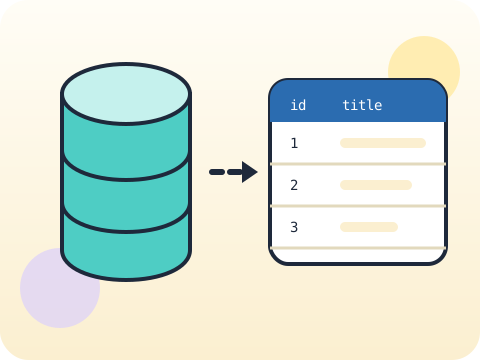
Students design schemas across related tables, implement full CRUD, and enforce integrity so the database itself refuses to hold contradictory data.
Schema design decisions are the hardest to reverse later. Getting them right early is enormously valuable.
Three core ideas, each taught with worked examples and then practised until it feels obvious.
Schema design decides tables, columns, types and relationships. Splitting data into related tables removes duplication and the errors duplication causes.
CRUD operations are implemented against a real schema, including the awkward cases such as deleting a record other records point at.
Data integrity is enforced with keys and constraints, so invalid data is rejected at the source instead of being caught later by hopeful code.
The relational model was proposed by Edgar Codd in a 1970 paper. Over fifty years later it still runs most of the world’s critical systems.
“The application will keep data valid.” Applications have bugs and change often. Constraints in the database are the durable guarantee.
Sessions 33–40 of the 72-session year, at two one-hour sessions per week.
Where this module fits, what you will build, and a hands-on starter that gets everyone curious about schema design.
Guided teaching on schema design, worked through together with the teacher.
Independent practice, small challenges and one deliberate mistake to diagnose.
Guided teaching on crud, building directly on the previous two sessions.
Applied tasks that combine schema design and crud in one piece of work.
Data integrity introduced and practised, completing the toolkit needed for the project.
Guided build session for the module project: Student service database.
Finish, test against the checklist, present the work and explain the decisions behind it.
Every module ends with something the student built themselves and can demonstrate. This is the piece that goes into their portfolio and gets explained out loud at the end of session 40.
Design a schema with at least three related tables, then deliberately try to insert contradictory data and confirm the database stops you.
Students finishing Module 5 can:
The vocabulary introduced here, in plain language:
6 quick questions drawn from this module — vocabulary, the project you build, and a myth-or-fact round. Every wrong answer explains itself, so a mistake still teaches you something.
Tell us your child’s class and what they enjoy. We will suggest the closest program fit—no pressure and no upfront payment.