CSV and JSON
CSV and JSON are the two formats most real data arrives in, and moving cleanly between them is a routine daily task.
Real data is messy, incomplete and occasionally lying. Build for that.
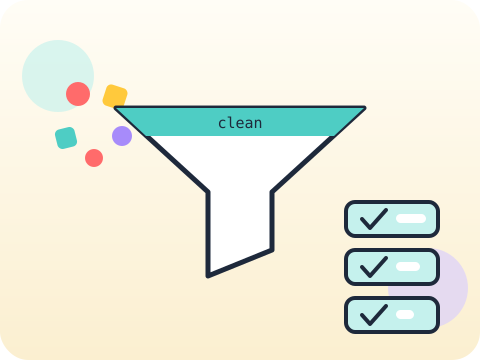
A pipeline moves data through defined stages — load, clean, validate, transform, output — with each stage separately testable, so the same process can be rerun on new data with confidence.
Pipeline thinking underpins data science, analytics and machine learning. Reproducibility is what makes results trustworthy.
Three core ideas, each taught with worked examples and then practised until it feels obvious.
CSV and JSON are the two formats most real data arrives in, and moving cleanly between them is a routine daily task.
Cleaning and validation handle blanks, duplicates, wrong types and impossible values — and record what was rejected rather than silently dropping it.
A transform pipeline chains reusable stages, so the whole process can be rerun on tomorrow’s data without editing anything.
Industry surveys consistently find data professionals spend most of their time cleaning and preparing data, not analysing it.
“Just delete the bad rows.” Sometimes correct, often not. Silently dropping data can change a conclusion completely — always log what was removed.
Sessions 25–32 of the 72-session year, at two one-hour sessions per week.
Where this module fits, what you will build, and a hands-on starter that gets everyone curious about csv and json.
Guided teaching on csv and json, worked through together with the teacher.
Independent practice, small challenges and one deliberate mistake to diagnose.
Guided teaching on clean and validate, building directly on the previous two sessions.
Applied tasks that combine csv and json and clean and validate in one piece of work.
Transform pipeline introduced and practised, completing the toolkit needed for the project.
Guided build session for the module project: Reusable data pipeline.
Finish, test against the checklist, present the work and explain the decisions behind it.
Every module ends with something the student built themselves and can demonstrate. This is the piece that goes into their portfolio and gets explained out loud at the end of session 32.
Build a pipeline for a genuinely messy public dataset, then run it on a second dataset without changing the code.
Students finishing Module 4 can:
The vocabulary introduced here, in plain language:
6 quick questions drawn from this module — vocabulary, the project you build, and a myth-or-fact round. Every wrong answer explains itself, so a mistake still teaches you something.
Tell us your child’s class and what they enjoy. We will suggest the closest program fit—no pressure and no upfront payment.