Abacus Mastery · Ages 5–11

Abacus classes in Hyderabad for focus, memory and number confidence.

A structured Soroban journey from physical bead movement to mental visualisation, delivered in small, supportive batches.

Ages 5–11Age range
10 levelsComplete pathway
24–36 monthsTypical duration
Max 8Children per batch
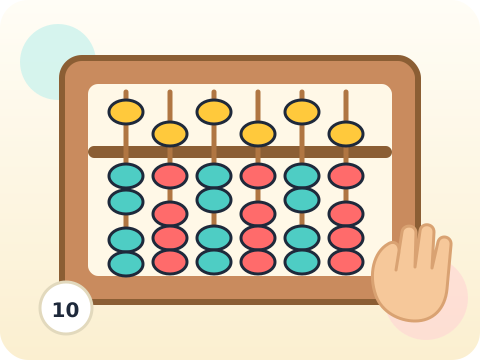
A wooden soroban abacus with amber and teal beads

Quick answer

Brolly Juniors runs abacus classes in Hyderabad for ages 5 to 11: a 10-level curriculum completed over two to three years, in batches capped at eight children. Children build calculation fluency, concentration, working memory and mental visualisation through structured practice and close instructor observation.

What the levels build, beyond arithmetic

Bead work asks for sustained attention, sequencing and visual memory—which is why parents usually notice the concentration change before the calculation speed.

  • Sustained concentration in short, repeated bursts
  • Working memory and mental visualisation
  • Listening accuracy through dictation sums
  • Confidence with numbers under mild time pressure
A wooden soroban abacus with amber and teal beads
Level-wise curriculum

Ten levels, grouped into five clear stages

Children move from moving beads with their fingers to seeing the beads in their head—one small, checked step at a time.

Levels 1–2

Soroban foundations

Correct finger technique and confident bead handling on the physical abacus.

  • Place value on the rods
  • Thumb and index finger technique
  • Simple addition and subtraction
  • Posture, pace and accuracy
Outcome: Adds and subtracts single digits on the abacus.
Levels 3–4

Small and big friend rules

The complement rules that make fast bead calculation possible.

  • Small friend (5) combinations
  • Big friend (10) combinations
  • Two and three-digit work
  • Timed accuracy drills
Outcome: Handles two-digit sums with the complement rules.
Levels 5–6

The mental transition

The abacus moves off the table and into visualisation.

  • Visualising the bead frame
  • Anzan (mental) addition rows
  • Dictation-style listening sums
  • Mixed physical and mental practice
Outcome: Calculates short rows entirely in the head.
Levels 7–8

Speed and complexity

Longer number strings, multiplication and division enter the pathway.

  • Multiplication on the Soroban
  • Division techniques
  • Three-digit mental rows
  • Speed-versus-accuracy checkpoints
Outcome: Completes multi-digit operations at pace.
Levels 9–10

Mastery and assessment

Fluency, endurance and the confidence to demonstrate it in front of others.

  • Long mental calculation sets
  • Level assessments
  • Competition-style practice rounds
  • Mastery demonstration
Outcome: Completes the 10-level pathway with a mastery demonstration.

Small batches, close observation

Classes stay capped at eight students so instructors can observe and correct bead technique, hand movement, pacing and accuracy individually.

💡

Understand

Clear explanation

🛠️

Practise

Guided activities

🏆

Create

Visible outcomes

Questions & answers

What families and schools ask

Can we attend a free trial before enrolling?
Yes. Every new family can book one free trial class to understand the teaching approach, meet the educator and confirm that the program is a good fit.
How large are Brolly Juniors batches?
Regular centre batches are capped at eight children so every learner can be seen, heard and supported. School-delivery formats are planned separately with the school.
Where is Brolly Juniors located?
The centre is on the 3rd floor of Dr Atmaram Estates at Nizampet X Roads, Hyderabad — beside Sri Bhramaramba Theatre and close to JNTU Metro Station, at metro pillar A689. It is open Monday to Saturday, 10:00 am to 7:00 pm.

Your child's free trial is one message away.

Tell us your child’s class and what they enjoy. We will suggest the closest program fit—no pressure and no upfront payment.