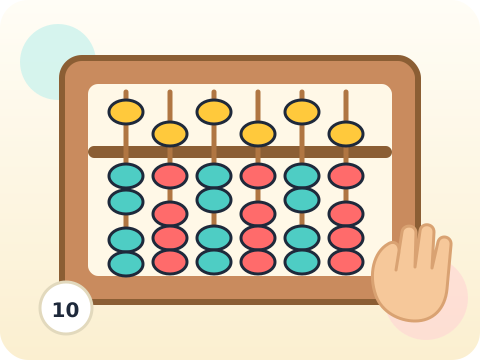
What abacus genuinely delivers
Three things, and they are real.
- Sustained concentration. This is the largest benefit and it is rarely the one advertised. Abacus practice is twenty minutes of unbroken, self-corrected attention on a repetitive task. Very little else in a modern child's week asks for that, and children who do it consistently get visibly better at sitting with difficulty.
- Working memory. Mental abacus requires holding a visualised bead position while operating on it. That is working memory under load, practised daily. It is one of the few cognitive capacities that responds well to deliberate training in childhood.
- Calculation fluency. A child two years in can add multi-digit numbers mentally, faster and more accurately than most adults. This is not a party trick — arithmetic that costs no effort frees attention for the actual problem in a word problem.
What it is oversold as
Three claims to treat sceptically, including from us.
- "It makes children good at maths." It makes children good at arithmetic. School mathematics past Class 5 is increasingly about reasoning, proof, algebraic structure and modelling. Arithmetic fluency helps — a child not burning effort on 47 × 6 has more attention for the actual question — but it is a support, not a substitute.
- "It develops the right brain" / "whole brain development". This language comes from marketing, not from evidence. The concentration and working-memory gains are real and sufficient; the neuroscience framing added on top is not.
- "Results in three months." Level 1 in three months, yes. Genuine mental calculation takes eighteen months to three years of consistent practice. Any program promising transformation in a term is selling the enrolment, not the outcome.
The one question to ask before you enrol anywhere
Ask what happens in a session when a child gets an answer wrong.
In a weak program the answer is "they redo the sheet". In a good one, the instructor watches the child's hands, identifies which complement rule broke down, and reteaches that specific rule. That difference is the entire value of the class — everything else is a worksheet you could buy.
It is also why batch size decides outcomes here more than in any other subject. An instructor cannot watch twenty pairs of hands. Ours are capped at eight for exactly this reason.
Abacus or Vedic Maths?
They are frequently sold together and they are not the same thing.
Abacus is a long, physical, visualisation-based training: two to three years, best started at five to seven, and the benefit is concentration and working memory as much as speed.
Vedic Maths is a set of pattern-based mental shortcuts: about twelve weeks, best from age seven upward once multiplication tables are in place, and the benefit is speed plus a genuine feel for how numbers decompose.
If a child is young and needs concentration, abacus. If a child is older, already competent, and wants to be faster, Vedic Maths. Doing both is reasonable, in that order, with a gap between them.