The three readiness signals that actually predict success
Before a child can map a sound to a letter, three things need to be roughly in place. None of them involve letters at all.
- They can hear sound patterns. Do they notice that "cat" and "hat" rhyme? Can they clap the two beats in "ba-nana"? This is the single strongest signal, and it is entirely an ear skill.
- They can hold attention for about ten minutes. Not an hour — ten focused minutes on one activity, with an adult, without needing to get up.
- They speak in full sentences. A child who is still speaking in two-word fragments needs spoken language to come first. Phonics will not fix that, and starting early will not speed it up.
A child with all three can start at four and will do well. A child missing the first one should spend a few weeks on rhyming games, clapping syllables and "what sound does mmmm-ilk start with?" before touching a letter card. That is not a delay — it is the actual first stage of the pathway.
What to do at each age
Rough guidance, with the caveat that individual children move at their own pace and the ranges overlap heavily.
- Ages 3–4: play, not programs. Rhyming books, songs, "I spy something beginning with sss". No worksheets. No formal class. This is where phonological awareness is built and it is built through the ear.
- Ages 4–5: the usual starting point. Most children can begin a structured phonics program here, learning pure letter sounds and blending their first three-sound words.
- Ages 5–7: still a completely normal start. A child beginning at six is not behind; they typically move faster through the early levels than a four-year-old does, because their attention and spoken language are further along.
- Ages 7+: start, and start properly. An older child who is still guessing at words needs systematic phonics more than anyone, not less. Skipping to "reading practice" is what created the problem. Our own program takes learners in Classes 1–3 who are still building reading confidence.
Sounds before letter names — the mistake that costs months
This is worth getting right, because it is the most common and most expensive error in early reading at home.
If a child has learned that the letter B is called "bee", they cannot use that to read the word "bat". Blending "bee-a-tee" produces nothing. The child concludes that reading is arbitrary and guesses at words from the pictures instead — a habit that takes far longer to unpick than it took to form.
Teach the pure sound: b as in the first fraction of "bat", clipped short, with no "uh" tacked on the end. Letter names come later, once reading is established, and they cause no trouble at that point.
Why the order of the sounds matters
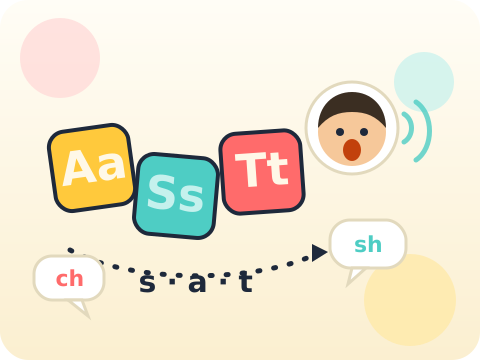
Good phonics programs do not teach the alphabet from A to Z. They start with s, a, t, p, i, n — a group chosen because those six sounds combine into more real words than any other six in English. A child who knows them can read "sat", "pin", "tap", "nap", "pit" and a few dozen others within the first fortnight.
That matters more than it sounds. A child who reads a real word in week one believes reading is something they can do. A child working alphabetically is still on B and C after two weeks, has read nothing, and has quietly concluded otherwise.
How long the whole thing takes
A complete synthetic phonics pathway usually runs nine to twelve months at two sessions a week, moving through six levels: sound awareness, blending, segmenting and spelling, digraphs and blends, long vowels and alternative spellings, then fluency and comprehension.
Children who join with some reading already in place are placed further along after a short readiness check, rather than being walked through material they have already mastered. Any program that puts every child at Level 1 regardless is managing its timetable, not the child.