Data questions
Data questions must be answerable by the data you actually have. Half of analysis is narrowing the question until it is.
The data is fine. The conclusion is where things usually go wrong.
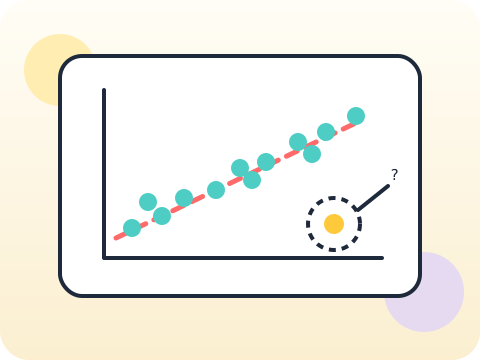
Students frame answerable questions, use AI to explore patterns and outliers, and practise stating conclusions with appropriate caution — including saying when the data simply cannot answer the question.
Drawing responsible conclusions is the hardest and most valuable part of data work, and the part most often skipped.
Three core ideas, each taught with worked examples and then practised until it feels obvious.
Data questions must be answerable by the data you actually have. Half of analysis is narrowing the question until it is.
Patterns and outliers both matter. An outlier can be an error, or it can be the most interesting thing in the dataset.
Responsible conclusions state what the data supports, what it does not, and what would be needed to be more certain.
Anscombe’s quartet is four datasets with identical means, variances and correlations that look completely different when plotted. Always plot the data.
“The AI analysed it, so the conclusion is sound.” AI describes patterns. Judging what they mean remains entirely human work.
Sessions 25–32 of the 72-session year, at two one-hour sessions per week.
Where this module fits, what you will build, and a hands-on starter that gets everyone curious about data questions.
Guided teaching on data questions, worked through together with the teacher.
Independent practice, small challenges and one deliberate mistake to diagnose.
Guided teaching on patterns and outliers, building directly on the previous two sessions.
Applied tasks that combine data questions and patterns and outliers in one piece of work.
Responsible conclusions introduced and practised, completing the toolkit needed for the project.
Guided build session for the module project: School-community data story.
Finish, test against the checklist, present the work and explain the decisions behind it.
Every module ends with something the student built themselves and can demonstrate. This is the piece that goes into their portfolio and gets explained out loud at the end of session 32.
Write your conclusion, then write the strongest honest objection to it. If you cannot answer the objection, soften the conclusion.
Students finishing Module 4 can:
The vocabulary introduced here, in plain language:
6 quick questions drawn from this module — vocabulary, the project you build, and a myth-or-fact round. Every wrong answer explains itself, so a mistake still teaches you something.
Tell us your child’s class and what they enjoy. We will suggest the closest program fit—no pressure and no upfront payment.