These two are marketed side by side so often that parents assume they are competing versions of the same thing. They are not remotely the same thing, and choosing the wrong one for a child's age is the most common reason either fails.
Numeracy · 6 min read
Abacus vs Vedic Maths: Which One, and When?
They are sold as alternatives and they are not. A side-by-side comparison of age, duration, what each actually trains, and how to choose between them.
Quick answer
Abacus is a two-to-three-year visualisation training best begun at age five to seven; it trains concentration and working memory as much as arithmetic. Vedic Maths is a twelve-week set of pattern-based mental shortcuts best begun at seven or later, once tables are secure; it trains speed and number sense. For a young child who needs concentration, choose abacus. For an older child who is already competent and wants to be faster, choose Vedic Maths. Doing both — abacus first, Vedic Maths a year or two later — works well.
The core difference in one line each
Abacus teaches a child to see numbers — to hold a bead configuration in the mind and manipulate it. The tool becomes internal, and the calculation happens in a mental image.
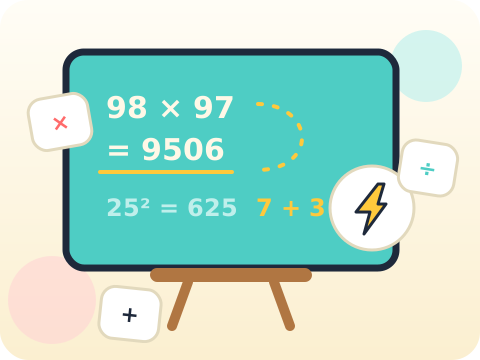
Vedic Maths teaches a child to restructure numbers — to notice that 98 × 97 is easier if you think of both as being near 100. There is no tool; there is a set of patterns and the judgement to pick one.
One trains visual working memory. The other trains number sense and flexible decomposition. Both produce fast mental arithmetic, by entirely different routes.
Side by side
| Abacus | Vedic Maths | |
|---|---|---|
| Best starting age | 5–7 | 7–13 |
| Typical duration | 2–3 years, 10 levels | ~12 weeks |
| Prerequisite | Numbers to 10, sits 15 minutes | Tables to 10, place value secure |
| Daily practice needed | 10 minutes, most days | Light — a few minutes |
| Primary gain | Concentration, working memory | Speed, number sense |
| Secondary gain | Calculation fluency | Confidence in maths class |
| Fails when | Started too young, or practice skipped | Taught as tricks without the reasoning |
How each one fails
Worth knowing, because both failure modes are avoidable and both are common.
Abacus fails when a child starts at four, cannot yet sit still, and concludes within a term that they are bad at it. It also fails quietly when the daily ten minutes stops — the skill is motor and visual, and it decays fast. Two years of class with no home practice produces very little.
Vedic Maths fails when it is taught as a bag of tricks to memorise. A child who knows the "nikhilam" shortcut but cannot say why it works has learned a magic spell, and it will not transfer to a number the trick does not fit. Taught properly, each method comes with the reasoning, and the child learns to choose a method — which is the actual skill.
Choosing between them
If you can only do one:
- Child is 5–7: abacus. The window for the concentration and visualisation benefit is genuinely age-sensitive, and Vedic Maths will still be there at nine.
- Child is 8–10 and struggles with speed but understands the maths: Vedic Maths. Twelve weeks, low commitment, visible result.
- Child is 8–10 and finds it hard to concentrate: abacus is still worth it, even started late. The concentration training is the point; the arithmetic is a by-product.
- Child is 11+: Vedic Maths, or neither. At this stage, time spent on algebra and reasoning generally beats time spent on arithmetic speed.
Doing both
The sequence that works is abacus first, from five to seven or eight, then Vedic Maths at nine or ten once tables and place value are secure.
By then the child already has strong mental visualisation from abacus, and Vedic Maths becomes a set of patterns they can see rather than memorise. Reversing the order works far less well, and running both simultaneously mostly produces confusion about which method to reach for.
Questions & answers
Related questions
Can a child do abacus and Vedic Maths at the same time?
We do not recommend it. The two use different mental strategies for the same operation, and a child running both at once tends to hesitate between them, which slows both down. Sequence them instead.
Which one helps more with school maths?
In primary classes, abacus, because most of that arithmetic is exactly what it trains. From Class 6 onward, Vedic Maths has a small edge — the number sense transfers into algebra a little better than bead visualisation does. Neither teaches the reasoning that school maths increasingly tests.
Is Vedic Maths worth it if my child is already good at maths?
Often yes, and it is the ideal candidate. A child who already understands the maths gets the most from methods that reveal structure, and twelve weeks is a small commitment. A child who is struggling with the underlying concepts should fix that first.
More guides
Other things parents ask us
Early reading
At What Age Should a Child Start Phonics?
Most children are ready for phonics between 4 and 5, but age is the weakest of the three readiness signals. Here is what actually matters, and what to do if your child is not there yet.
Read the guide →NumeracyIs Abacus Good for Kids? An Honest Assessment
What abacus training genuinely does for a child, what it is oversold as, and how to tell whether it is worth two to three years of your family's Saturdays.
Read the guide →TechnologyShould My Child Learn AI or Coding First?
AI literacy and programming are different skills that solve different problems. Which one to start with depends on your child's age and temperament — here is how to decide.
Read the guide →Your child's free trial is one message away.
Tell us your child’s class and what they enjoy. We will suggest the closest program fit—no pressure and no upfront payment.