Lists and dictionaries
Lists and dictionaries together cover most needs: a list of dictionaries is the standard shape for records, one dictionary per row.
Data has a shape. Match the shape and the code almost writes itself.
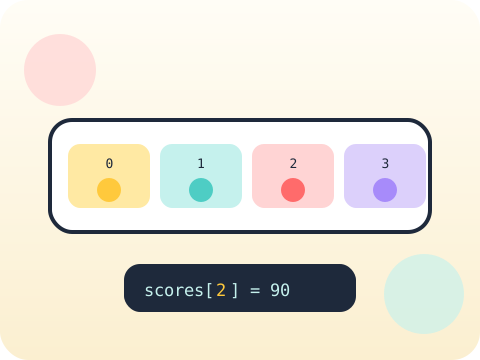
Students compare lists, dictionaries and sets, learn what each is genuinely good at, and practise nesting them to model real information such as a library, an inventory or a timetable.
Structure choice is where beginners and capable programmers visibly diverge. The right structure turns a hard problem into an easy one.
Three core ideas, each taught with worked examples and then practised until it feels obvious.
Lists and dictionaries together cover most needs: a list of dictionaries is the standard shape for records, one dictionary per row.
Sets store unique values and answer membership questions instantly. They are the fastest way to remove duplicates or find what two groups share.
Nested structures let one object hold another — a book dictionary containing a list of borrowers, and each borrower a dictionary of their own.
Checking whether an item is in a set of a million values takes microseconds. The same check on a list of a million may need to inspect every single one.
“Sets are just lists without duplicates.” They are also unordered, which means you cannot ask for “the third item” at all.
Sessions 9–16 of the 72-session year, at two one-hour sessions per week.
Where this module fits, what you will build, and a hands-on starter that gets everyone curious about lists and dictionaries.
Guided teaching on lists and dictionaries, worked through together with the teacher.
Independent practice, small challenges and one deliberate mistake to diagnose.
Guided teaching on sets, building directly on the previous two sessions.
Applied tasks that combine lists and dictionaries and sets in one piece of work.
Nested structures introduced and practised, completing the toolkit needed for the project.
Guided build session for the module project: Library catalogue.
Finish, test against the checklist, present the work and explain the decisions behind it.
Every module ends with something the student built themselves and can demonstrate. This is the piece that goes into their portfolio and gets explained out loud at the end of session 16.
Model your school library as nested data, then answer three questions with code: which books are out, who has most, and which are never borrowed.
Students finishing Module 2 can:
The vocabulary introduced here, in plain language:
6 quick questions drawn from this module — vocabulary, the project you build, and a myth-or-fact round. Every wrong answer explains itself, so a mistake still teaches you something.
Tell us your child’s class and what they enjoy. We will suggest the closest program fit—no pressure and no upfront payment.