Manipulated media
Manipulated media includes deepfake video, cloned voice and altered images. Knowing what is possible is the first defence.
If a video can be faked perfectly, what still counts as proof?
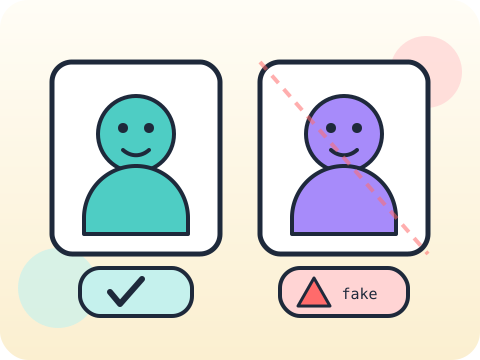
Students learn to spot manipulated media, understand the scams built on it, and adopt verification habits — with the honest caveat that detection is getting harder, so source-checking matters more than eye-checking.
This is direct personal safety. Voice-clone scams targeting families are already common in India.
Three core ideas, each taught with worked examples and then practised until it feels obvious.
Manipulated media includes deepfake video, cloned voice and altered images. Knowing what is possible is the first defence.
Privacy and scams: the more of your voice and face is public, the more material exists to imitate you.
Verification habits are simple and effective — check the original source, call back on a known number, and agree a family code word.
Many families now use an agreed code word for emergency phone calls, specifically because a familiar voice is no longer proof of identity.
“I would spot a deepfake.” Studies show people perform close to guesswork. Verification beats intuition every time.
Sessions 57–64 of the 72-session year, at two one-hour sessions per week.
Where this module fits, what you will build, and a hands-on starter that gets everyone curious about manipulated media.
Guided teaching on manipulated media, worked through together with the teacher.
Independent practice, small challenges and one deliberate mistake to diagnose.
Guided teaching on privacy and scams, building directly on the previous two sessions.
Applied tasks that combine manipulated media and privacy and scams in one piece of work.
Verification habits introduced and practised, completing the toolkit needed for the project.
Guided build session for the module project: Deepfake awareness workshop.
Finish, test against the checklist, present the work and explain the decisions behind it.
Every module ends with something the student built themselves and can demonstrate. This is the piece that goes into their portfolio and gets explained out loud at the end of session 64.
Agree a family code word this week, and explain to a grandparent exactly why it is now necessary.
Students finishing Module 8 can:
The vocabulary introduced here, in plain language:
6 quick questions drawn from this module — vocabulary, the project you build, and a myth-or-fact round. Every wrong answer explains itself, so a mistake still teaches you something.
Tell us your child’s class and what they enjoy. We will suggest the closest program fit—no pressure and no upfront payment.